For fifty years, the tools that make institutional traders successful were locked behind eight-figure minimums.
We unlocked them.
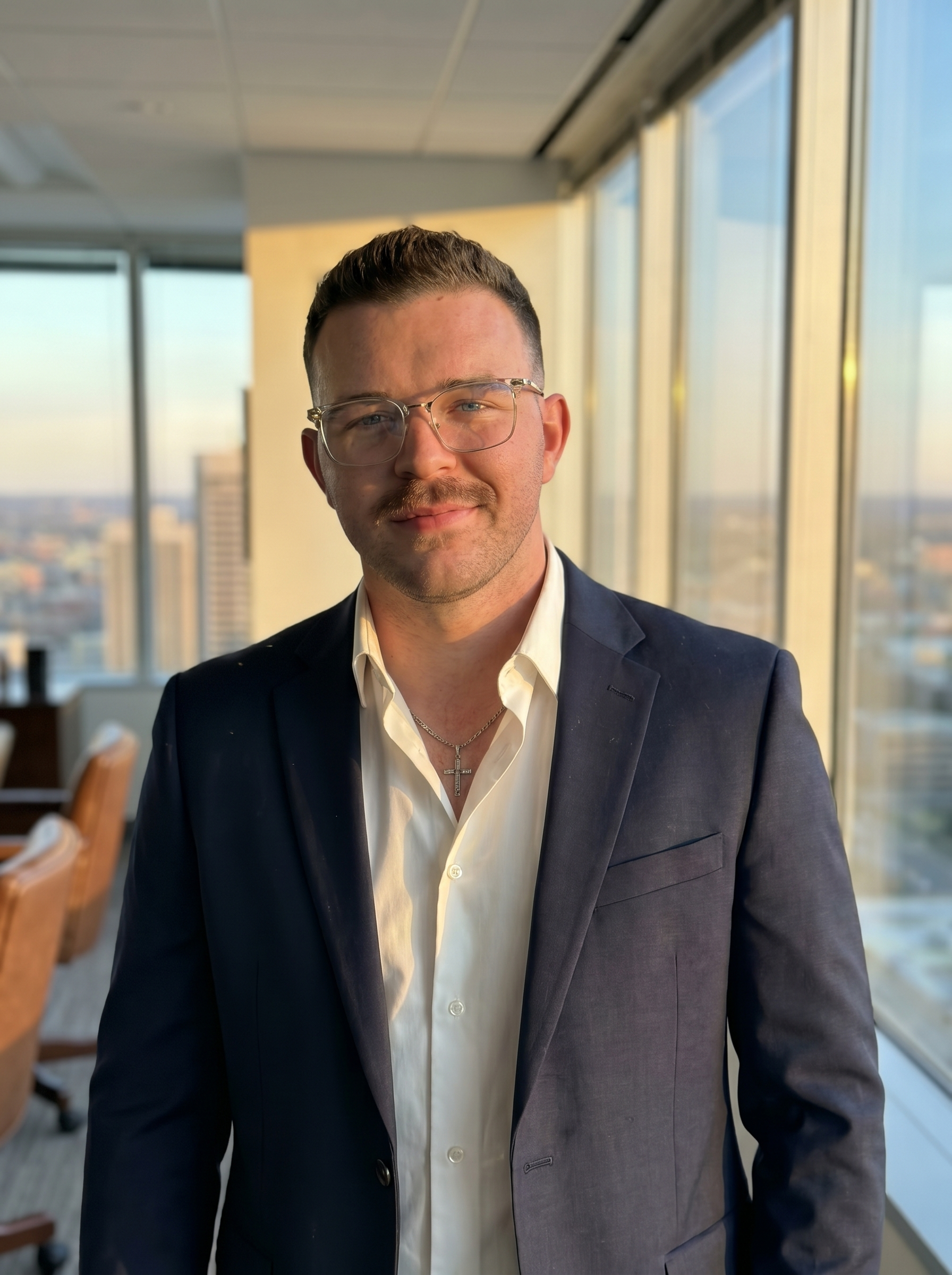
Founder & CEO
Asher Walk
The man behind the technology
Asher Walk has spent his career inside the rooms where institutional capital is actually priced and traded.
A U.S. Navy veteran turned quantitative strategist, Asher built decision-support systems for eight-figure clients before founding Sentinel to bring that same technology to self-directed traders.
Asher's career didn't start on a trading floor. It started in the U.S. Navy, where he spent three years of active service.
The Navy was where he learned the things that would later define how he ran his work: precision, systems thinking, and the discipline to follow process under pressure. He left with a different relationship to chaos than most people his age — and a deep respect for the systems that hold up under it.
02The crossover
The math floor.
After his service ended, Asher crossed into the quantitative side of Wall Street — the math floor, where humans don't pick stocks by feel. They build systems that do.
It was the first time he saw how serious institutional traders actually think about the market. Not as a feed of news and tickers, but as a stream of signals — most of them noise, a few of them real — and a question of how to tell the difference, fast, at scale, without ever fooling yourself.
03The desk
Lead algorithmic strategist.
Asher became a lead algorithmic strategist at one of the top quantitative trading firms in the world — the kind of firm with eight-figure client minimums and a years-long waiting list just to be considered.
Inside, he built the decision-support systems institutional traders rely on every day. Engines that scan, score, and surface. Frameworks that pair raw computational scale with the judgment of professionals. He spent years building precisely the kind of technology that, on the outside, almost nobody had access to.
04The realisation
Behind the locked door.
For five decades, the kinds of tools Asher worked on every day stayed where they were built — inside institutions that priced access in the millions. Self-directed traders were left scanning charts by hand and reading the same news everyone else read.
The technology existed. It worked. It had been refined for fifty years. It just wasn't available. That was the gap. That was the thing that wouldn't leave him alone.
05Six years on
Founding Sentinel.
Six years ago, Asher set out to build a platform that paired the scale of an institutional research engine with the judgment of a quantitative desk — not for hedge funds, but for the self-directed trader.
He didn't release version one. He didn't release a beta. He spent six years refining the engine, building the desk, testing the model in live markets until the data was undeniable. Then — and only then — he opened the door.
Sentinel is what came through it.
The philosophy
What Asher believes about markets — and why Sentinel exists at all.
Sentinel isn't an accident of timing. It's the product of a few specific convictions about how modern markets actually work, and what a self-directed trader is actually up against.
i.
Markets are won by systems, not by feel.
The era where a smart, well-read human could reliably out-read the tape ended decades ago. Today, more than seventy percent of U.S. equity volume is executed by algorithms running inside the world's largest firms. The advantage doesn't go to the most insightful analyst. It goes to the system that sees a setup first and acts on it cleanly.
ii.
An algorithm without a human is a liability.
The same firms that built the algorithms also built the desks that supervise them. Software alone is reckless in markets — it can't read a news item, a Fed announcement, a geopolitical shock, or a tape that's simply behaving in a way the model wasn't trained on. Every serious institutional system has a hand on the brake. Sentinel does too.
iii.
Self-directed traders deserve the same tools.
For fifty years, the tools that work were reserved for capital that already had it. There's no good reason for that other than incumbency. The technology is built, refined, and battle-tested. The infrastructure exists. The only thing missing was someone willing to build a version designed from the ground up for the self-directed trader — without compromising on either side of the model.
Most people picture a trading floor as a room full of people shouting at screens. The truth is that the rooms that matter are quieter than that. They're full of people who built something, and then watched it carefully. That's what we wanted to bring to the self-directed trader — quiet, careful, watchful technology.
Asher Walk
Founder & CEO · Sentinel Capital
How we work
Three habits that shape every decision we make.
These aren't marketing language. They're the practical, day-to-day choices that make Sentinel feel different from the moment a client opens a dashboard.
We release nothing we wouldn't trust ourselves.
Every setup that reaches a client dashboard has been approved by a member of the quantitative desk personally. If a setup wouldn't pass our own internal review, it doesn't go out. Period.
We explain the reasoning, every time.
Every approved setup arrives with the full picture — what the engine saw, the desk's review notes, and the price levels that define entry, invalidation, and risk. No mystery outputs. No black boxes. You see the reasoning, every time.
We're slow when we need to be.
If the desk isn't comfortable, we don't surface a setup. If volatility is unusual, we pull back. If the market is doing something the engine hasn't seen before, we pause. The default state is restraint, not output.
The team
A desk drawn from the rooms where institutional capital is traded.
Sentinel's quantitative desk includes specialists with decades of combined hedge-fund and trading-desk experience. We let the work speak — but here's what stands behind it.
$150M+
Combined trading capital
Experience managing institutional capital across Hong Kong hedge funds and Wall Street quantitative desks.
Decades
Of desk experience
Years inside the rooms where institutional risk is priced, traded, and reviewed every single day.
6 yrs
Building Sentinel
Six years of platform development before the doors opened. No beta. No version one. Released only when the data was undeniable.
24/7
Hand on the brake
The desk has discretion to pause, hold, or veto any setup during volatility, news, or anything the engine can't read.
What we believe
Five principles. Non-negotiable.
Everything Sentinel does is filtered through these. They're the reason the platform looks the way it does, and the reason it doesn't look like a lot of other things.
01
Your account. Your name. Your control.
Sentinel does not custody, hold, or pool client funds at any time. You hold your own brokerage account in your own name, and you retain full discretion at all times. We provide research and decision-support — never a hand on your account.
02
Software, not discretion.
Sentinel surfaces equity setups. We don't make personalised investment recommendations and we don't trade on anyone's behalf. The difference is structural and intentional: it keeps your control over your own capital intact.
03
Humans on the wheel, always.
An engine without a desk is reckless. A desk without an engine is too slow. Every setup the AI surfaces is reviewed by a quantitative specialist before it ever reaches a client dashboard. We don't ship outputs we wouldn't sign off on personally.
04
Transparent by default.
Every approved setup arrives with the full picture: what the engine saw, why the desk approved it, the levels that define entry, invalidation, and risk. No black box. No mystery outputs. You see the reasoning, every time.
05
Compliance is a feature.
Decision-support, not discretionary advice. Software, not brokerage. The structure is built deliberately to keep your control intact and to fit cleanly inside the lines — not because we have to, but because the alternative is the kind of business we don't want to run.
Where we are
Headquartered in Tampa, Florida.
Sentinel operates out of one office on East Jackson Street. Engineering, the desk, and client support all sit in the same building. Write in any time — the address opposite is where we'll be.
Headquarters
401 East Jackson Street, Suite 2340 Tampa, FL 33602 United States
Sentinel works with a limited number of self-directed traders at any one time.
If Sentinel fits what you're building, the next step is a short written application. We review every submission personally and follow up within two business days.
What's the outcome you're hoping to achieve by working with Sentinel?
Take a few sentences. What would success look like for you? What's the underlying reason you're considering this?
Please share a bit about your goal — at least a couple of sentences so we can understand the fit.
Question 02 of 04
What makes you a great fit as a Sentinel client?
Sentinel works with a deliberately limited number of clients. Help us understand who you are — your background, your discipline, your approach to investing. Be honest, not promotional.
Please share a bit about yourself — what would make you a strong fit as a client.
Question 03 of 04
What capital do you have available to invest?
An approximate range is fine. This helps us determine the right tier of platform access and ensure we can match you with the appropriate desk resources.
Please select a capital range to continue.
Question 04 of 04
Last step — how do we reach you?
Once you submit, one of our team members will review your application and contact you within 12 hours by phone and email.
Please complete all fields. We'll need each one to follow up properly.
Thank you. Your application has been received.
One of our in-house team members is reviewing your application now. We'll contact you via phone and email within the next 12 hours.